This Is What Happens When Art Takes Over a City
Yogyakarta isn’t just another stop on the map—it’s where culture breathes through every wall, alley, and studio. I stepped off the scooter expecting temples and tradition, but what I found was a city pulsing with creative energy. Underground galleries, street murals that tell stories, and artists turning ordinary spaces into magic. If you think Indonesian art stops at batik and wayang, think again. Yogyakarta’s art spaces are raw, real, and impossible to ignore. This is not a city that displays art—it lives it, breathes it, and invites you to feel it in your bones. Here, creativity isn’t reserved for museums or elite circles; it spills onto sidewalks, echoes in courtyards, and transforms forgotten corners into open-air galleries. This is what happens when art takes over a city.
The Soul of Yogyakarta: Where Tradition Meets Rebellion
At first glance, Yogyakarta appears steeped in quiet tradition. The Kraton, or royal palace, stands as a living symbol of Javanese heritage, where court ceremonies continue with precision and grace. Gamelan music drifts through morning air, and batik artisans still dip cloth into wax by hand. Yet beneath this surface of reverence lies a restless pulse of innovation. Yogyakarta is not merely a guardian of culture—it is a reinterpreter, a challenger, a creator. This duality is the foundation of its artistic soul, where centuries-old customs coexist with bold, experimental expression.
The city’s identity as Indonesia’s cultural heart is no accident. As a center of learning and royal patronage, Yogyakarta has long nurtured intellectual and artistic inquiry. The presence of Gadjah Mada University and the Indonesia Institute of the Arts (ISI) has cultivated generations of thinkers, performers, and visual artists. ISI, in particular, plays a pivotal role in shaping the city’s creative direction. Its curriculum balances traditional Javanese arts with contemporary theory, encouraging students to question, deconstruct, and reimagine. This academic environment fosters a spirit of inquiry that extends far beyond campus walls.
What sets Yogyakarta apart is its tolerance for dissent and experimentation. Unlike more commercialized Indonesian cities, where art often serves tourism or luxury markets, Yogyakarta’s scene thrives on dialogue and social reflection. Student-led movements have historically driven cultural change, from performance art protests in the 1990s to recent community-based installations addressing environmental issues. The city does not demand conformity; it rewards curiosity. Artists are not expected to replicate the past but to engage with it, to ask what tradition means in a modern, globalized world.
This blend of respect and rebellion creates a fertile ground for innovation. The royal court continues to support traditional dance and music, while just a few kilometers away, young artists use digital media to critique urban development. Batik patterns inspire abstract paintings that comment on identity and migration. The past is not discarded—it is reimagined. In Yogyakarta, art is not separate from life; it is a form of civic participation, a way of understanding where the city has been and where it might go.
Beyond the Canvas: Art in Unexpected Places
One of the most striking aspects of Yogyakarta’s art scene is its refusal to stay within boundaries. Galleries exist, of course, but the true energy of the city’s creativity spills into places where art is least expected. An old textile factory in the Baturetno district now hosts immersive light installations, its crumbling brick walls amplifying the contrast between decay and renewal. A former warehouse near the Malioboro railway line has been transformed into a rotating exhibition space, where sound art echoes through empty halls once filled with machinery. These are not curated exceptions—they are the norm.
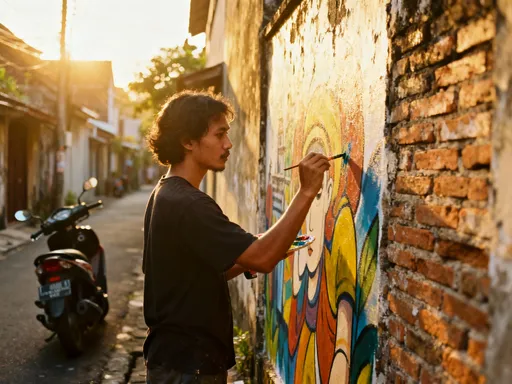
Walking through neighborhoods like Tirtodipuran or Sosrowijayan, you might stumble upon a sculpture made of recycled metal embedded in a sidewalk, or a temporary mural painted on the shutter of a closed shop. These interventions are not always announced or promoted; they simply appear, like whispers in the urban fabric. Some last only a few days before being painted over or dismantled, while others become landmarks in their own right. The impermanence is part of the point—art here is not about permanence or prestige, but about presence, about making people pause and see their surroundings differently.
The sensory experience of encountering art in these spaces is profound. In an abandoned printing press turned gallery, the scent of turpentine lingers in the air, mixing with the dampness of old concrete. Sunlight filters through broken skylights, casting shifting patterns on a video projection about memory and loss. In a narrow alley behind a warung, a kinetic sculpture made of bicycle parts creaks softly in the breeze, its motion powered by wind and imagination. These moments are not passive observations—they are invitations to engage, to listen, to feel.
What makes this possible is a collective understanding that urban space belongs to everyone. Unlike in cities where public art requires permits, committees, and budgets, Yogyakarta operates on a more organic logic. Artists negotiate directly with building owners, community leaders, or even neighbors. A shopkeeper might allow a mural on his shutter because he likes the design or supports the artist’s message. A landlord might offer a vacant ground-floor unit for a month-long installation because he remembers being young and broke and full of ideas. This informal economy of trust and mutual respect is essential to the city’s artistic vitality.
Cemeti Art House: A Legacy in Motion
No discussion of Yogyakarta’s art scene is complete without acknowledging Cemeti – Institute for Arts and Society, one of Southeast Asia’s most influential independent art spaces. Founded in 1988 by artists Nindityo Adipurnomo and Mella Jaarsma, Cemeti began as a home-based gallery in a quiet residential neighborhood. What started as a modest experiment in self-organized exhibition-making has grown into a regional hub for critical dialogue, experimental practice, and international collaboration.
Cemeti’s evolution reflects the broader trajectory of contemporary art in Indonesia. In its early years, it provided a rare platform for artists to present work that challenged political and social norms, often at a time when such expression was risky. It hosted performances, installations, and discussions that questioned authority, identity, and cultural boundaries. Over time, it became a meeting point for artists from across Indonesia and beyond, fostering exchanges that helped shape the region’s contemporary art discourse.
What makes Cemeti unique is its commitment to process over product. It does not function like a commercial gallery seeking to sell art, nor does it operate as a museum preserving finished works. Instead, it supports research, experimentation, and dialogue. Artists are invited to develop projects over weeks or months, often in residence, with access to studio space, technical support, and critical feedback. The result is work that is deeply considered, socially engaged, and often difficult to categorize.
Cemeti also plays a crucial role in connecting local artists with global networks. It has hosted curators, scholars, and artists from Japan, the Netherlands, Australia, and elsewhere, facilitating residencies, workshops, and joint exhibitions. These exchanges are not about importing foreign ideas, but about creating space for mutual learning. Indonesian artists gain exposure to international perspectives, while visiting practitioners gain insight into local contexts, histories, and concerns. This two-way flow strengthens the integrity of the work and ensures that Yogyakarta remains part of a global conversation without losing its distinct voice.
Jalan Bisma and the Rise of Artist Collectives
While Cemeti represents a cornerstone of institutional independence, the true grassroots energy of Yogyakarta’s art scene thrives in its collectives. In neighborhoods like Baturetno, Tirtodipuran, and around Jalan Bisma, small groups of artists have created their own ecosystems of support, experimentation, and community. These collectives—such as Ruang MES 56, Tongkospace, and ruangrupa (before its members relocated to Jakarta)—are not formal organizations with boards and budgets, but fluid, self-organized networks driven by shared values and mutual care.
Ruang MES 56, for example, operates out of a modest compound where studios, exhibition spaces, and a small library coexist. Artists work side by side, borrowing tools, sharing meals, and critiquing each other’s work informally. Open studio days invite the public to wander through, talk to creators, and witness art in its most vulnerable stages—sketches on the wall, half-finished sculptures, notebooks filled with ideas. There is no barrier between artist and audience, no sense that you need special knowledge to belong.
Tongkospace takes a different approach, focusing on interdisciplinary collaboration and social engagement. It hosts workshops on everything from natural dyeing techniques to community mapping, often in partnership with local farmers, elders, or schoolchildren. One project involved creating a series of textile banners based on oral histories from women in a nearby village, blending craft, storytelling, and activism. These initiatives are not about producing saleable art, but about building relationships and preserving knowledge that might otherwise be lost.
What unites these collectives is a commitment to accessibility and shared ownership. They reject the notion of the artist as solitary genius, instead emphasizing collaboration, mentorship, and collective learning. Young graduates from ISI often find their first real creative home in these spaces, where they are encouraged to take risks without fear of failure. Visitors are not passive observers but potential participants. You might arrive to see an exhibition and end up helping install a piece, joining a discussion, or even contributing an idea. This democratization of art-making is at the heart of Yogyakarta’s appeal.
Street Art with a Message: Murals That Speak
Wander through Yogyakarta’s side streets and you’ll encounter murals that do more than decorate. They communicate, challenge, and mourn. Unlike the decorative or purely aesthetic street art found in some cities, Yogyakarta’s public paintings often carry weighty themes—environmental degradation, social inequality, the erosion of cultural values. A large mural near the Gadjah Mada campus depicts a child holding a dying coral reef, surrounded by plastic waste. Another, painted on the side of a community center, shows a traditional Javanese puppet figure weeping as skyscrapers rise behind it.
These works are not acts of vandalism. In many cases, they are commissioned or tolerated by local authorities, who recognize their value in sparking public conversation. Some are created in collaboration with neighborhood associations or schools, turning the process of painting into a community event. The artists behind them—often working under collectives like Tembok Rupa or Street Anatomy—see their role not as entertainers but as storytellers and witnesses.
The tolerance for socially critical art in Yogyakarta is remarkable, especially in contrast to other Indonesian cities where such expressions might be censored or removed. This openness is rooted in the city’s long tradition of intellectual freedom and civic engagement. Universities, artists, and activists have historically enjoyed a degree of autonomy, allowing difficult topics to be addressed through creative means. A mural criticizing consumerism might feature a shopping cart filled with batik cloth, symbolizing the commodification of culture. Another shows a rice field being paved over, with the words “Where will we eat when the land is gone?” written in Javanese script.
These murals do not offer solutions, but they insist on awareness. They transform passive urban viewers into active observers, asking them to consider their role in larger social and environmental systems. For visitors, they provide a powerful entry point into the city’s concerns and values. You don’t need to speak the language to feel the urgency in the imagery. The art speaks in universal terms—loss, longing, resistance, hope.
Crafting the Experience: How to Engage Like a Local
Experiencing Yogyakarta’s art scene is not about ticking off a list of must-see spots. It is about slowing down, listening, and allowing yourself to be surprised. The best time to visit studios and collectives is late afternoon, when artists return from teaching or errands and the light slants through open windows. Weekends often bring open studios, small performances, or informal gatherings over tea and snacks. Joining an art walk organized by a local guide or cultural initiative can provide context and access to spaces that might otherwise go unnoticed.
When entering non-commercial spaces, a few simple courtesies go a long way. Always ask before taking photographs, especially of works in progress or people. Many artists appreciate conversation, but not all speak fluent English—a smile, a notebook, or a shared snack can bridge the gap. If you’re invited to stay for a meal or discussion, consider it a privilege. These moments of connection are often more meaningful than any formal exhibition.
To fully appreciate the rhythm of creative life in Yogyakarta, combine gallery visits with time in surrounding spaces—a quiet bookshop selling independent publications, a warung serving traditional Javanese dishes, or a small stage where students rehearse experimental theater. The art does not exist in isolation; it is woven into the daily life of the city. A mural gains depth when you’ve tasted the local food, heard the street vendors call out, felt the humidity rise at dusk.
For those planning a visit, consider timing your trip around key events like the Yogyakarta Art Fair or the annual Festival Kesenian Yogyakarta, which celebrates local culture through performance, craft, and visual art. These gatherings offer a concentrated dose of creativity, but the true magic lies in the quieter moments—a chance encounter with a painter in a courtyard, a spontaneous conversation with a curator, the discovery of a hidden installation behind a market stall.
Why This City Can’t Be Imitated
Many cities try to replicate the success of artistic hubs like Berlin, Mexico City, or Lisbon. They build galleries, invite international artists, and declare districts “creative zones.” But Yogyakarta cannot be copied, because its power does not come from infrastructure or branding, but from something deeper—a culture of freedom. Here, art is not driven by market value or institutional approval. It grows from a shared belief that creativity is a public good, a form of expression that belongs to everyone.
The absence of heavy commercial pressure allows artists to take risks, to fail, to experiment without fear. There are no gallerists demanding sellable pieces, no collectors dictating trends. This does not mean art here is without value—on the contrary, it carries moral, social, and emotional weight that transcends price. The freedom to create without gatekeepers fosters a rare authenticity, a sense that what you are seeing is not curated for consumption, but offered in sincerity.
Moreover, Yogyakarta’s art scene is rooted in social consciousness. It does not exist for its own sake, but as a response to the world—to environmental change, to cultural shifts, to the needs of communities. This grounding in reality gives it resilience and relevance. As global art markets chase novelty and spectacle, Yogyakarta remains quietly committed to meaning.
Yet this delicate ecosystem is not immune to change. Rising tourism, urban development, and commercial interest could alter the city’s character in the coming years. What is accessible today may become exclusive tomorrow. That is why now is the time to visit—not as a spectator, but as a witness. Come not to collect experiences, but to understand a city where art is not an addition to life, but a way of living it. This is what happens when art takes over a city. And once you’ve felt it, you’ll never see creativity the same way again.